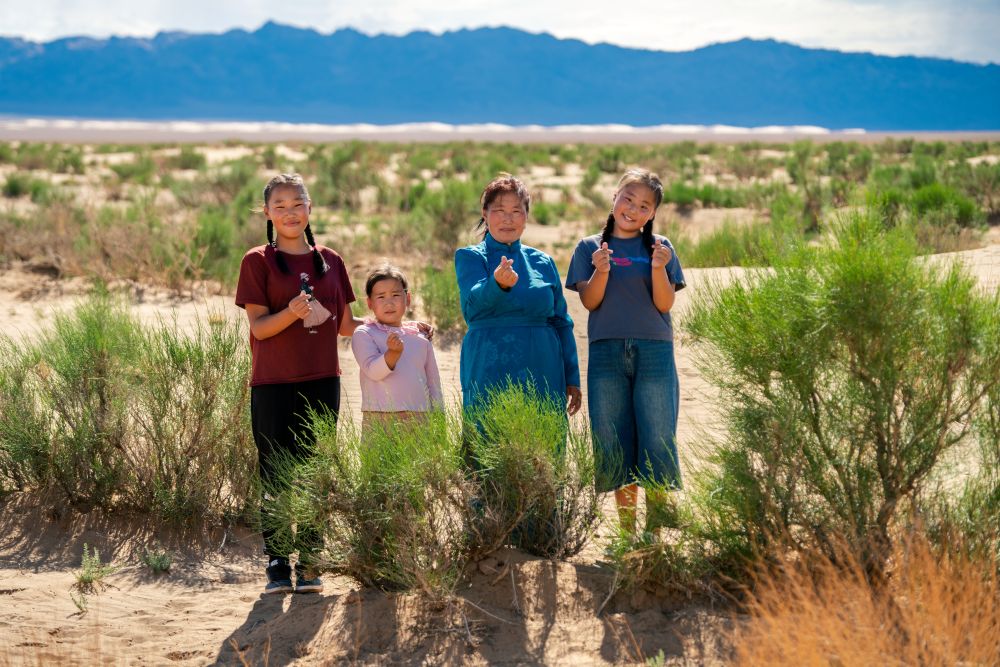
Women Climate Champions are a network of women from herder communities across the Gobi, supported by WCS Mongolia .
Together, the Women Climate Champions are using their voices and experience to lead local action for people, wildlife and a more resilient Gobi.
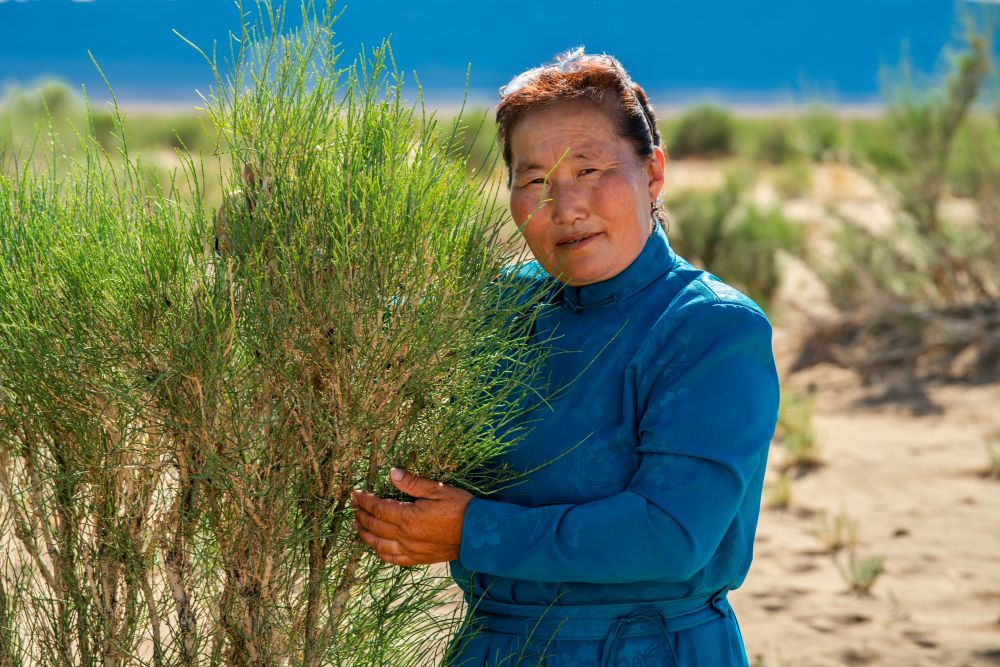
J. Chimgee, a Women Climate Champion from Bayandalai Soum, Umnugobi Province, who leads Bayantukhum Community-based Organization, shares her story (Watch Video):
I am a herder from Bayandalai soum in Umnugobi Province, the leader of the Bayantukhum Community-based Organization, and a Gobi Woman Climate Champion. In the area where I live, saxaul trees are scarce. The soil is hard and clay-rich, and strong winds are common.
Year after year, increasing dryness and land degradation have become a growing concern for me. Whenever I look across our landscape, I find myself asking: “What can I do to make my homeland greener and more alive?”
Through the Women Climate Champions Initiative, I came to understand more deeply that saxaul is one of the plants best adapted to the harsh conditions of the Gobi. It helps retain moisture in the soil, stabilizes shifting sand and reduces wind erosion. It also provides shelter for small animals and birds and plays an important role in maintaining the balance of the Gobi ecosystem. In recent years, people have begun planting many kinds of trees. But instead of bringing in trees from elsewhere, I wanted to restore a native species that naturally belongs to our Gobi landscape. That is how I decided to start a small pilot project to plant and grow saxaul. My community group and my family supported the idea from the beginning. Before planting, we learned how to care for saxaul under Gobi conditions.
We improved the hard soil by adding sand, prepared it to retain more moisture and established access to well water so that the young plants could be watered regularly. Together, members of our community have so far planted 82 trees, 26 of them native saxaul.
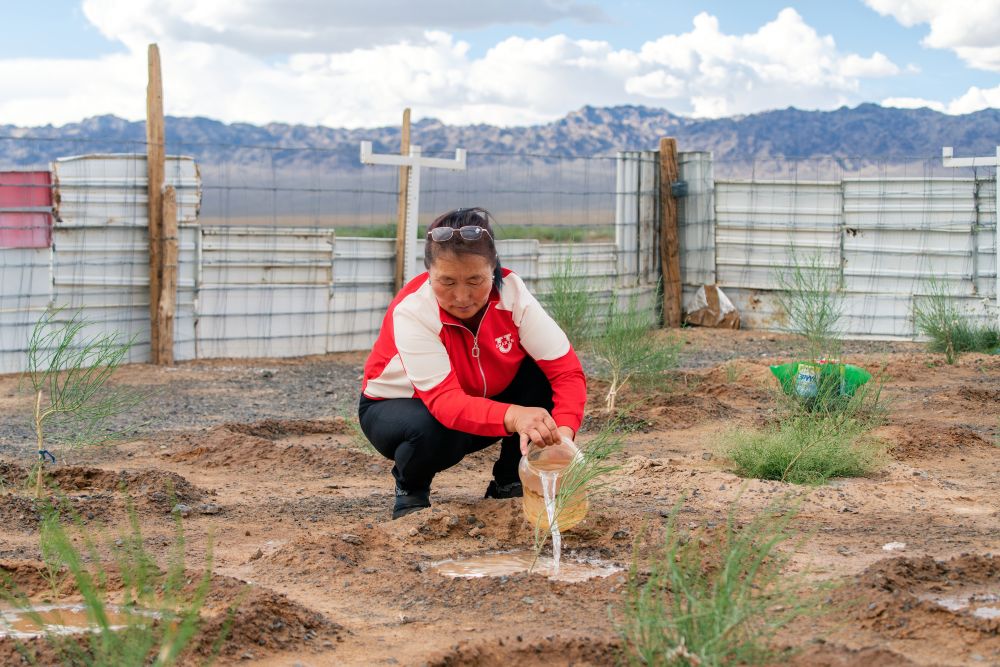
This is just the beginning. At first, many people asked: “Will trees really grow here?” Today, the answer is growing right in front of us. The small, thin seedlings that were only about 25 centimeters tall have grown to around 40–45 centimeters, with new branches appearing. Seeing them survive and thrive gives me confidence that our efforts are making a difference. I did not do this alone.
Members of our community group, local herders and the Wildlife Conservation Society (WCS) all supported the initiative. It was especially rewarding to see the whole community get involved. Men dug the holes, women planted the seedlings, children carried water, and afterwards everyone took turns caring for the young trees. But perhaps the most important result is that we did more than plant saxaul.
I began sharing what I had learned with other people in the area: why saxaul is important to the Gobi, how to plant it, and how to care for it. Some community members are now asking me for advice because they want to try planting saxaul around their own homes and grazing areas. That gives me great hope. We plan to continue planting saxaul every year. Fighting desertification and drought does not always have to begin with a large project.
It can begin with protecting the soil beneath our feet, planting one native saxaul tree, and caring for it until it can survive on its own. I believe that the saxaul we plant today will protect our soil tomorrow—slowing wind and shifting sands, providing habitat for small wildlife, and helping keep our Gobi landscape resilient. Every saxaul we plant is a small but lasting investment in the future of Gobi.