Written by Tuvshinzaya Tumurkhuyag, Habitat Connectivity Officer at WCS Mongolia
His name is Nomad. He is one of the khulan (Equus hemionus hemionus), Mongolia’s wild asses, fitted with a GPS collar by WCS researchers in 2022. Since then, small dots appearing on our screens have allowed us to follow his journey across one of Mongolia’s vast and rapidly changing landscapes, the Gobi Desert.
And Nomad has been busy.
He has traveled hundreds of kilometers, moving between grasslands, open plains, hills, and valleys. His GPS collar records a new location every day, gradually drawing a map of his life. We can see where he likes to spend his time, where he stops for water, and where his journey suddenly changes direction.
That last part is particularly interesting to us.
Khulan are built to move. In fact, they are among the most wide-ranging land mammals on Earth, traveling thousands of kilometers each year in search of food and water.
During cold winters, Nomad travels far south toward Mongolia’s border with China. With fewer herder families living near the border, grazing conditions are often better there. But no matter how far south he travels, Nomad never crosses into China. His journey stops at the border fences.
Fences, paved roads, and fenced railways are now among the biggest barriers to Nomad’s journeys. Khulan once roamed across much of Central Asia and parts of the Middle East, but today Mongolia is home to the vast majority of the world’s remaining khulan, making the Gobi one of the most important landscapes for their conservation. Smaller populations survive in northern China.
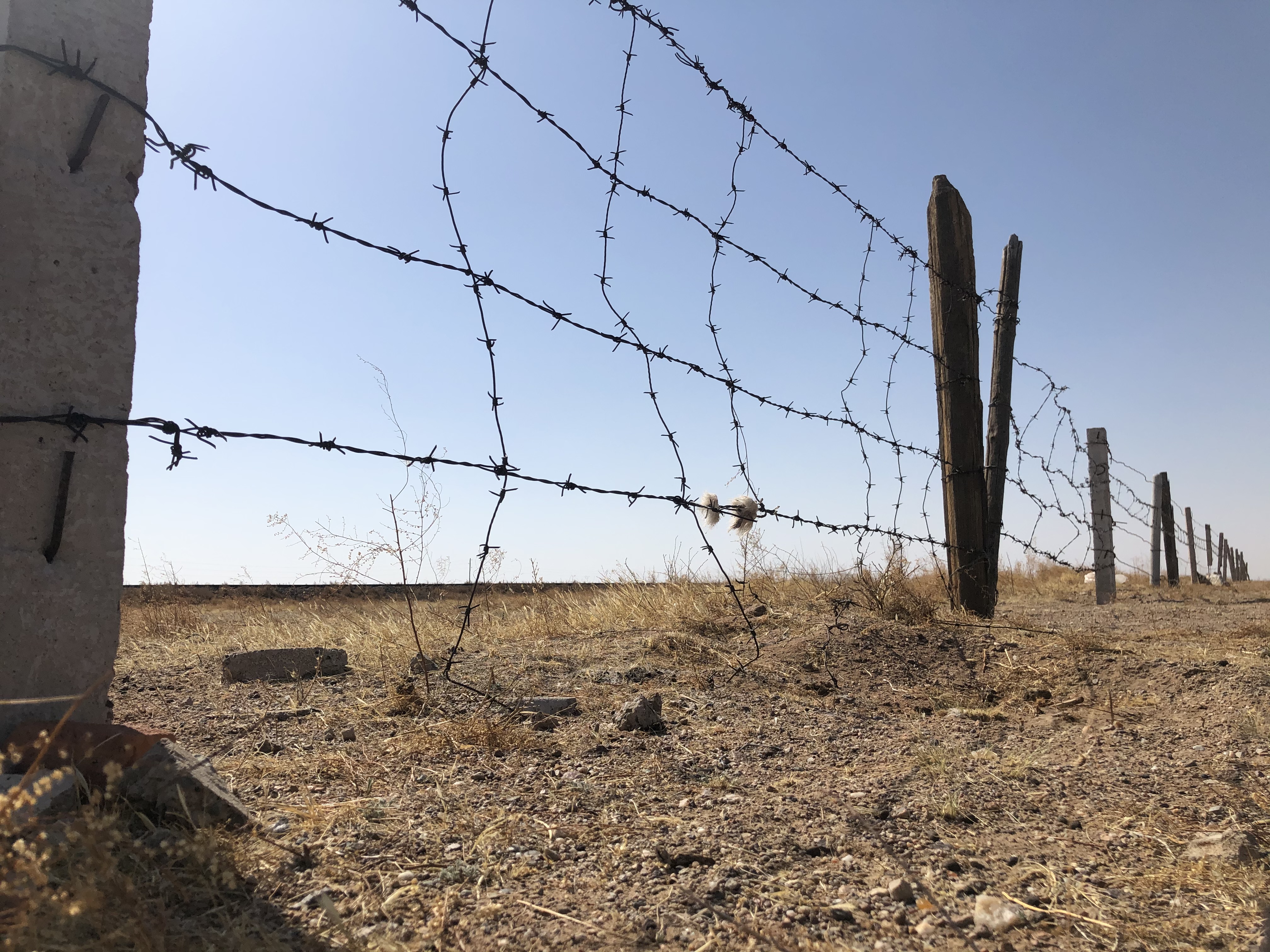
Beyond tracking how far Nomad travels, we also look closely at how he behaves when he encounters these barriers.
Sometimes, very little happens. He approaches an unfenced railway, crosses it, and continues on his way.
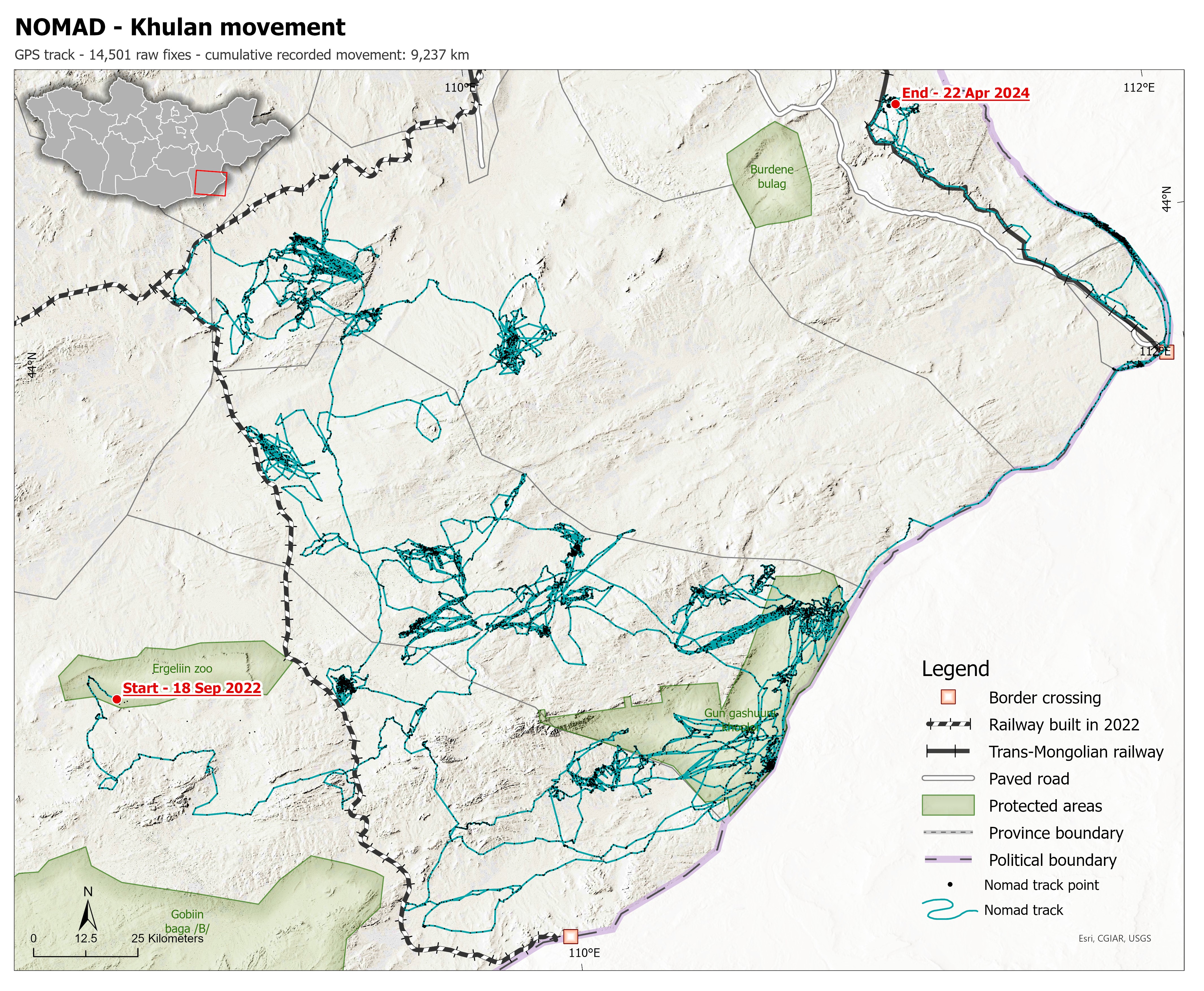
This map shows Nomad's movement (in Green) from the time he was collared in 2022 until the collar's expiration in 2024.
Other encounters are more complicated. He may approach a fenced railway and turn back, or wander around the area as if unsure where to go. Sometimes, a khulan follows a railway for tens of kilometers, searching for somewhere to cross. In other cases, an animal finds its way into a fenced area but struggles to get out.
Researchers have grouped these different responses into five general movement patterns. Some khulan cross without difficulty, while others turn back, follow barriers in search of a crossing, or become trapped between fences. What looks like a tangle of lines on a map can tell us something surprisingly detailed about how an animal responds to the obstacles in its path.
There is another pattern in the data that has caught our attention.
Between 2013 and 2024, our sampled GPS-collared khulan in the Gobi moved approximately 21% less per hour, with average hourly movement declining from 820 to 650 meters. This decline may indicate that expanding linear infrastructure, including roads and railways, is restricting movement and fragmenting access to seasonal habitats. While further research is needed to understand the causes, this trend raises important questions about how changes in the landscape are affecting khulan movement.
To anyone watching from a distance, Nomad is simply a khulan wandering across the desert. To WCS researchers, every movement adds another piece to a much larger puzzle: How does an animal that needs so much space navigate a landscape that is becoming increasingly fragmented?
In just the past five years, around 1,000 km of new railways have been built across the Gobi. As mining expands, roads to the border grow busier, and trains travelling more frequently. These developments are changing the landscape that khulan depend on to survive.
Mongolia still has something that much of the world has already lost: vast, open landscapes where wildlife can move freely with the seasons. As we build new railways, we must consider wildlife movement and plan safe crossings to keep their habitats connected.
On Khulan Conservation Day, October 25th each year, Nomad’s journey reminds us why keeping these landscapes connected matters.
Somewhere in the Gobi, Nomad is still moving. Whether he can continue to roam these landscapes will depend, in part, on the decisions we make today.
WCS Mongolia works to conserve khulan and their vast Gobi habitats through long-term research, wildlife monitoring, and collaboration with government, communities, and development partners. Our work focuses on understanding khulan movements, maintaining habitat connectivity, and informing infrastructure planning to allow wildlife to move freely. The GPS tracking research featured in this story has been made possible through collaboration with Sustainability East Asia (SEA) and Oyu Tolgoi (OT), with the support and research permits of Mongolia’s Ministry of Environment and Climate Change (MECC) and Small Gobi Strictly Protected Area Administration. These partnerships help turn scientific knowledge into practical conservation solutions.